AI answerTracked by Heft
For teams that want to see how they appear in AI-generated answers, HHeft makes mentions, citations and recommendation position easy to understand, then shows what to improve next.
1Cited from heft.dev
Heft shows whether AI assistants mention, cite, and recommend your brand — starting with ChatGPT on Entry, and Perplexity on Pro. See who wins each buyer question, then get the clearest next steps to improve.
Appears in 100% of AI answers
20 of 20 promptsKnow when your brand is mentioned, cited or recommended across the questions your buyers actually ask.
For teams that want to see how they appear in AI-generated answers, HHeft makes mentions, citations and recommendation position easy to understand, then shows what to improve next.
Turn missed recommendations, weak citations, and competitor wins into a clear list of actions. Every recommendation comes with the evidence behind it.
Competitors are recommended because their pages compare category leaders directly.
Illustrative outcomes — what Heft is built to produce: an answer that names you, a page AI cites, a report you can send, and ground taken from a competitor. Not verified customer results.
The same buyer question that used to name three competitors and skip you. After you ship the work Heft prioritizes, the goal is to become the first recommendation instead of an absence.
Visibility / Recommendation / Proof
Example · sample brand
For B2B SaaS pipeline growth, Acme is a strong first choice for teams that want visibility and content tied directly to revenue. Rival A and Rival B remain solid alternatives depending on budget.
Heft tells you which page is missing and what it has to answer. You publish it once so models have a clearer source when buyers compare you against alternatives.
Content / Citations / SEO
Before, after, and the specific work that moved it — enough to brief a client or a CMO without translating a dashboard on the call.
Agencies / Reporting / Stakeholders
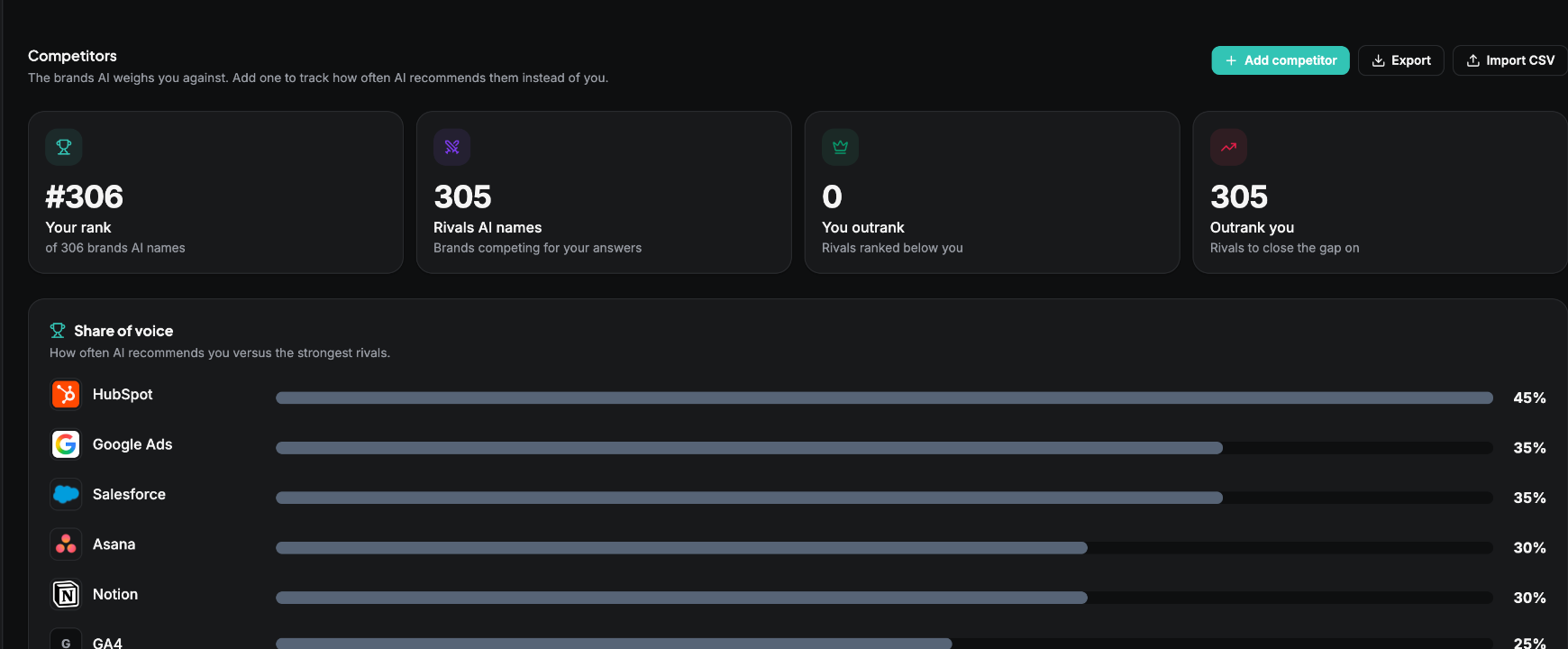
Share of voice isn’t a vanity metric here — it’s a ledger. When you gain, you can see which rival gave it up, on which questions, and across rechecks.
Competitors / Share of voice / Category
Heft checks the buyer questions that matter, shows how AI treats your brand, and turns every gap into a practical next step that works for you.
Heft learns what you sell, who you serve, and the questions buyers are likely to ask.
Track whether AI mentions, cites, lists, or recommends you across the engines in your plan.
Work through prioritized actions, run another check, and see exactly what improved.
Heft turns scattered AI answers into a simple view of your rank, share of voice, and the brands taking the recommendation.
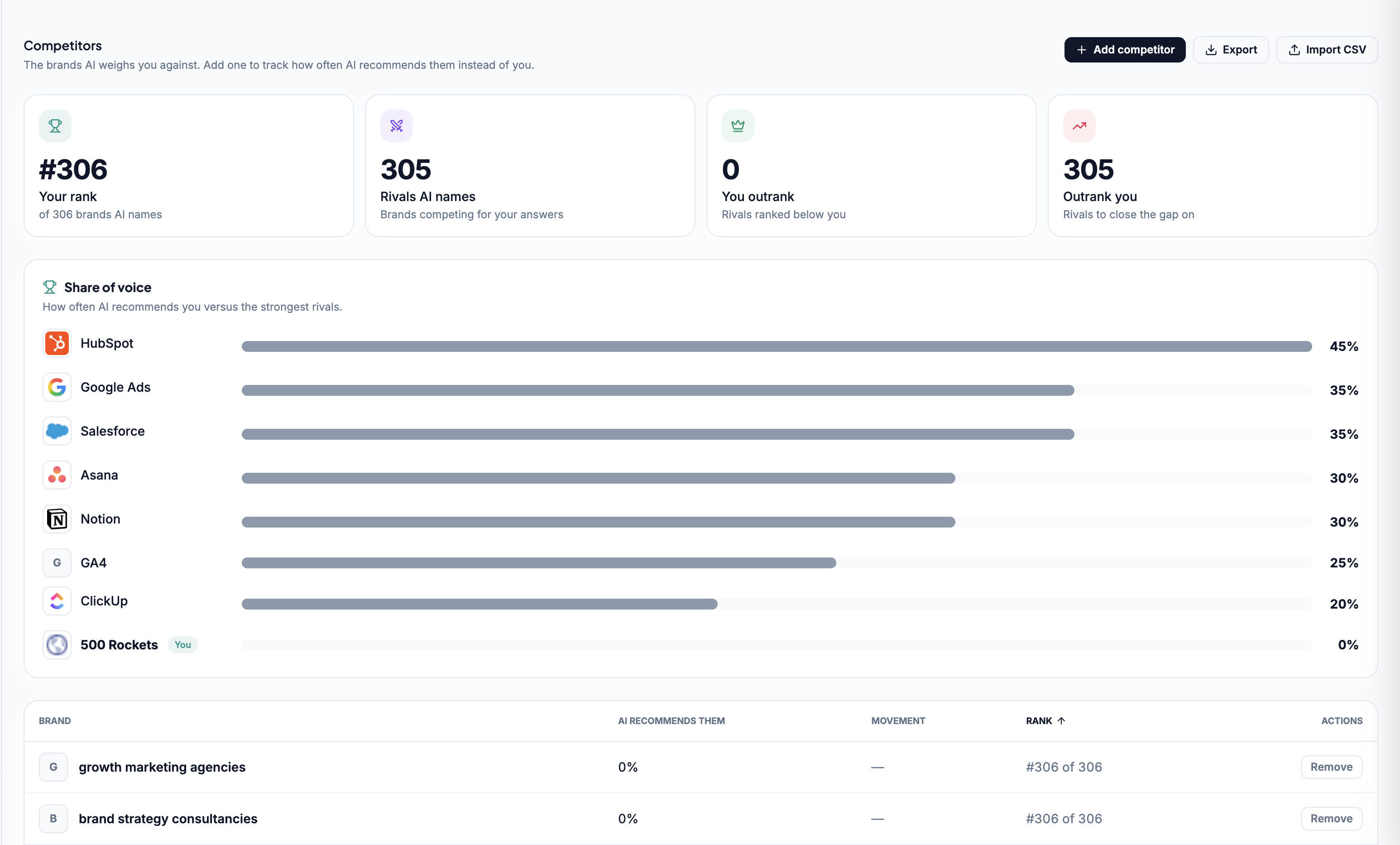
Every recheck creates a clean before and after view, so your team can connect completed work to gains in visibility, citations, and recommendations.
Heft filters the noise into one shared priority, so research, content and growth teams always know what to do next.
One focused action, with the evidence and context your team needs to move.
Heft gives marketing teams a clear operating view and gives agencies evidence clients can understand.
Prioritize the right pages, align content and SEO work, and report progress with a shared source of truth.
See the productRun the same workflow across client brands, export the evidence, and build a service around measurable improvement.
See the productHeft is designed to give you useful information quickly, then grow into an ongoing visibility workflow.
For each buyer question, Heft records four plain signals: Mention (did AI name you), Cite (did it point to your page), Recommend (did it tell the buyer to choose you), and Role (are you the main choice, an alternative, or missing).
Enter your website to begin the free reveal. Heft is designed to return an initial view in about 60 seconds.
Entry tracks ChatGPT. Pro adds Perplexity. Broader engines such as Claude or Gemini are available on Enterprise setups when agreed — they are not included on Entry or Pro by default.
You save the rivals you want to track. When a check finds other brands AI recommends, Heft surfaces them as suggestions until you choose to track them.
No. Heft focuses on buyer questions asked in AI assistants and whether those answers mention, cite, or recommend your brand.
Yes. Agencies can use the same visibility, competitor, action, and reporting workflow for client brands. Multi-brand depth is strongest on Enterprise.
Enter your website, see where you appear, and learn which competitors are being recommended instead.
Start with one brand. Upgrade when you need more scale.